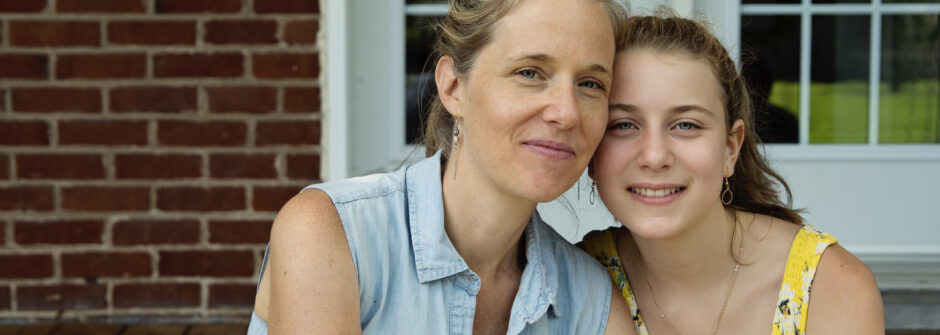
The Strength of the Ensemble
Hannah's Story
For most high school seniors, the future is a wide-open map. But for 17-year-old Hannah, the last few years have been about reclaiming the ground beneath her feet.
Hannah had always been a tremendous student and a “theatre kid”—someone who found her voice and her community on the stage. But in the 8th grade, a quiet internal struggle began to shift and become more complex. Her mother Audrey—a mental health clinician—watched as her daughter’s vibrant personality began to fade.
“She went from a bright, vivacious girl to someone we didn’t recognize,” Audrey recalls.
What started as anxiety, focus issues, and sleeping troubles spiraled with the introduction of medication which, unbeknownst to everyone, exacerbated underlying symptoms of early psychosis. A series of confusing and often frightening episodes left the family reeling. Hannah became increasingly paranoid and fearful of her own neighbors, and she was often saying things that didn’t make any sense.
“We were feeling so deflated,” Audrey says. “She was checked out. We were constantly having to bring her back to reality.”
Despite being under the care of world-class specialists who truly cared about Hannah’s well-being, the family found themselves navigating a fragmented system. Doctors didn’t talk to counselors; medications were trialed and failed; and Hannah’s school was left without a clear roadmap on how to help.
“My friend had mentioned the Cedar Clinic as a program we should look into, and coincidentally, our doctor at Boston Children’s knew Dr. Stern from The Brookline Center. She told us that Hannah needed a higher level of care and that we were possibly dealing with a mood disorder with psychosis,” Audrey recalls. “Getting that news was so shocking—that’s a lifelong thing. I don’t think we even had a chance to react; we were just constantly in crisis. I made a call to The Brookline Center’s CEDAR team, left a message, and they reached out the very next day—I was so overwhelmed, but grateful to speak to them. I cried through the whole conversation.”
CEDAR (the Center For Early Detection, Assessment & Response to Risk), is a clinical program of The Brookline Center for Community Mental Health, and is comprised of a team of mental health clinicians working to help youth (ages 12-30) and families understand and treat puzzling changes in thinking, feeling, or behavior. Through CEDAR’s clinical services, including diagnostic consultation; individual therapy; family support and parent coaching; psychiatry; and school/work coaching, patients and their families have a better understanding of what they’re facing—and a clear path forward.
While Hannah awaited her CEDAR evaluation, she began reacting poorly to her new medication. and her mental health continued to deteriorate.
“It was really scary,” Audrey says. “One day, she woke up and said I wasn’t her real mother, and that Whitney Houston or another celebrity was her real mother. We were showing her the family albums, telling her all of the nicknames we had for her since she was a baby, but she was terrified and we were all crying.”
Audrey eventually had to call 911, and she and Hannah then had to be taken by ambulance to the ER where she continued to deteriorate. She was quickly transferred to a nearby inpatient unit where she spent the next two weeks. Hannah was miserable and started having an allergic reaction to a commonly used (but new to her) medication that had previously shown promise. The discharge was tenuous, and the family was anxious about the transition to a whole new clinic with different providers while still in acute crisis mode.
“From there we connected with Dr. Stern and Charlene (a CEDAR therapist) again,” Audrey remembers. “They were very calming and validating. Hannah started meeting with Charlene, and they were all so helpful with the process of Hannah getting an IEP and having the appropriate and useful accommodations included which the school had already initiated prior to her hospitalization”.
At the school’s suggestion, and with Dr. Stern, Charlene, and Michelle’s (family therapist) recommendations, Hannah’s care was coordinated with the school’s bryt room, which allowed her to return to class at her own pace.
“There were so many adjustments for us as parents in terms of expectations,” Audrey says. “But we really started to celebrate the little triumphs—like Hannah being able to complete three math problems when that had seemed impossible a few weeks earlier. But we had this whole team working together and communicating on her behalf—it just felt like a warm hug, they really know what they’re doing.”
Slowly, carefully, a foundation was forming.
One of the most profound moments of healing happened where Hannah felt most at home: the theater. When vying for the lead was no longer feasible, Hannah moved to the ensemble, but her symptoms began to manifest in rehearsals, prompting the school to reach out to Audrey and Dave. In the past, this might have led Hannah to leave the program entirely. Instead, the CEDAR team worked with Audrey and Dave to support with the process of advocating the school principal and directors to “soften” the environment. School staff provided education to her peers and formulated a plan that allowed her to stay and feel both supported and included.
It was a pivot that required immense courage on Hannah’s part, proving that her diagnosis didn’t have to mean a departure from doing the things she loved most.
Today, the “constant crisis” has been replaced by a sustainable rhythm. Hannah is a senior, preparing for a major milestone that feels possible because of the foundation she built at The Brookline Center.
She’s looking to attend college locally in Massachusetts—a strategic choice to keep her CEDAR team within reach as she navigates this next chapter of independence.
“It’s so incredible to have a team,” Audrey reflects. “She feels like she has a team, too. That’s the most important thing for her so that she continues to find strength and resources within her chosen village of providers. We have an amazingly loving and supportive extended family, and now Hannah also has this dedicated and knowledgeable team of mental health professionals that she has grown to appreciate and trust. It’s invaluable to all of us.”
At The Brookline Center, we’ve always believed what Hannah’s story makes clear: recovery isn’t a solo performance. It took a therapist and a psychiatrist, a family therapist, a school principal and a bryt team, family support, peers who were educated, and fiercely dedicated parents. It took courage, coordination, and care—and it took Hannah herself to be willing to step back on stage and shine.